
Say "rugby" in Cardiff and someone pictures a driving lineout maul. Say it in Castleford and they picture a winger sliding over in the corner off a fifth-tackle shift. Same word, two sports, and more than a century of argument about which one is the real thing. If you have only ever watched one code, the other can look bizarre for the first ten minutes: scrums that end in nothing, a tackled player standing up and rolling the ball backwards with his boot, a penalty worth two points instead of three. None of it is random. Every difference traces back to a decision someone made on purpose, usually to make the game faster.
Two codes, one ancestor
Union and league descend from the same nineteenth-century English game. The split came in 1895, when clubs in the north of England broke away from the Rugby Football Union over compensation for players who missed work on Saturdays — the "broken time" dispute. That group became rugby league. Union stayed amateur until 1995, while league was professional from the start, and that single fact shaped everything that followed.
Once separated, the two rulebooks drifted far apart. League cut teams from 15 players to 13 to open up the field, abolished the lineout in 1906, and turned the scrum into a way of restarting play rather than a contest for the ball. Union kept the lineout, the pushing scrum and the wrestle for possession on the ground. Watch five minutes of either sport and you are watching the consequences of those choices.
The breakdown: the clearest dividing line
After a tackle, the codes do opposite things.
In union, the ball is live. The tackler must release it, arriving players must stay on their feet, and a flanker can rip possession away or win a penalty for his side. This is the ruck, and referees' interpretation of it decides matches more than any other factor. A team can lose a game on three breakdown penalties in ten minutes without the opposition scoring a try.
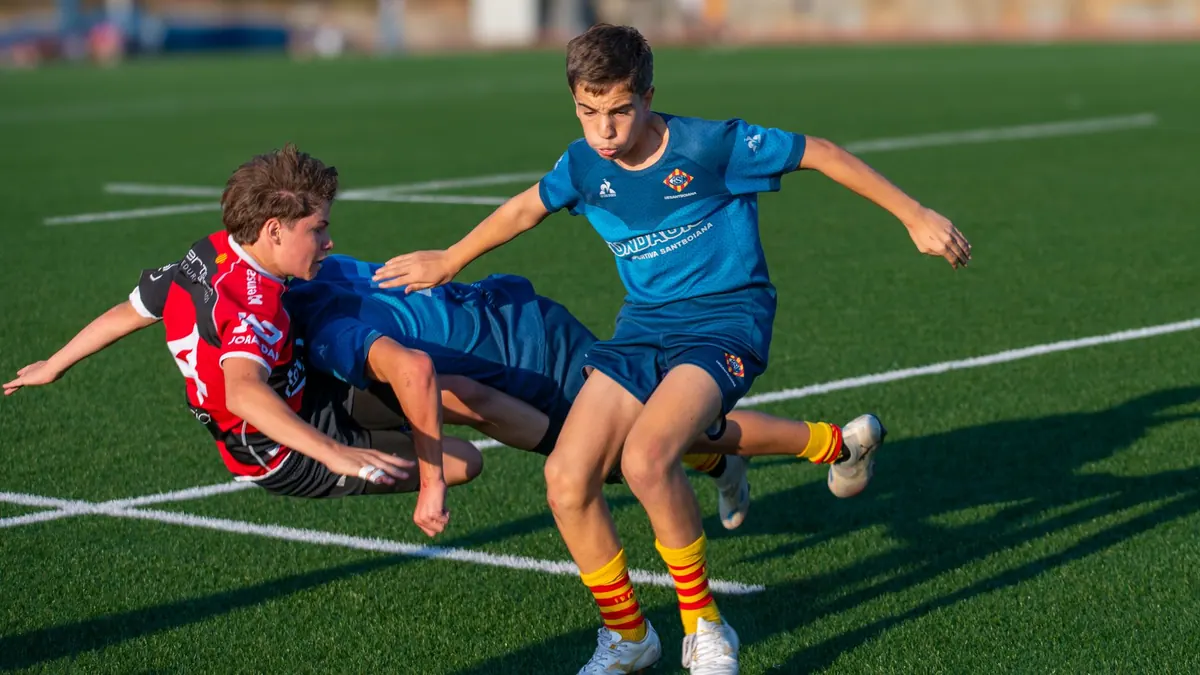
In league, the ball is not contested. The tackled player gets to his feet and plays it backwards with his foot to a teammate, usually the dummy half who stands behind him. Defenders retreat and set their line. Possession is safe for that play, which is why league coaches talk endlessly about completion rates: dropping the ball is the most expensive mistake in the sport.
Set pieces, or what is left of them
- Scrums. Union packs contest, push and can win a penalty or a turnover. League scrums are a restart — the ball is fed in, the packs barely engage, and possession almost never changes hands.
- Lineouts. Union only. League removed them and hands possession to the non-offending team instead, usually as a handover or a scrum.
- Restarts. Union has the 22 drop-out and the 50:22. League has the 20-metre restart and the 40/20 kick, both designed to reward a well-placed boot with field position.
Scoring: small numbers, big consequences
Both codes reward a try and a conversion, then diverge sharply.
- Try: five points in union, four in league.
- Conversion: two points in both, taken from in line with where the try was scored.
- Penalty goal: three points in union, two in league.
- Drop goal: three points in union, one in league, where it is normally called a field goal.
Those gaps change behaviour. In union, a dominant pack that keeps winning scrum penalties can bank points three at a time without ever threatening the try line, and a drop goal is a genuine weapon in a tight final ten minutes. In league, a one-point field goal turns the last tackle of a set into a live calculation: take the shot, or kick for the corner? Some competitions settle tied matches with a golden point period, and that single point decides them.
Six tackles versus endless phases
Game flow is where the two sports feel least alike.
League runs on sets of six. Complete six tackles and possession hands over. Teams build a set like a hole: two carries to get off your own line, a couple of shifts to an edge, then a kick on the last — a bomb, a grubber, or a swing at a 40/20. Field position is the currency. Because the defensive line retreats ten metres from the play-the-ball, every set has a clear, visible shape you can read from the stands.
Union has no tackle count. A side can keep the ball through twenty phases if it likes, but the risk compounds with every one: hands in the ruck, a turnover at the jackal, a knock-on under pressure. Coaches talk about earning the right to go wide, which means winning the collisions and the breakdown first. The offside line at a union ruck is a foot behind the ball rather than ten metres back, so defence is tighter, messier and far more improvised.
Clock, cards and fresh legs
Both games last 80 minutes, but they treat the clock differently. League uses a stop clock for scrums, drop-outs, conversions and video reviews, plus shot clocks that limit how long teams can take over each one, so matches finish close to the advertised time. Union leans on the referee to play advantage and add time, and a long scrum sequence or a television match official review can eat several minutes.
Discipline looks broadly similar: a yellow card and ten minutes in the bin, a red card and you are gone. Substitutions are another matter. Union typically names a bench of eight replacements, and once a player is off he normally stays off unless it is a blood or head injury assessment. League uses interchanges — a bench of four rotated on and off in short bursts, with a limited number allowed — which is why league forwards can sprint into collisions for the full eighty.
How to watch your first match in each code
A few practical habits make either sport click faster than any explainer.
- In league, follow the count. Say the tackle number out loud. Within a set or two
Photo: Pablo Hsm / Pexels